
A local business citation is any online mention of your business name, address, and phone number, known as your NAP. Get these consistent across the web and Google is far more confident showing your business in local search results. The single most important thing you can do right now is define your canonical NAP, then claim your Google Business Profile.
Here are three actions you can take within the hour:
- Define your canonical NAP. Decide on the exact spelling, abbreviations, and format you will use everywhere. "St." or "Street"? "Ltd" or "Limited"? Pick one and write it down.
- Claim your Google Business Profile. For UK service providers, this is the highest-priority listing and the fastest route to appearing in Google Maps and the local pack.
- Fix your top-tier listings. Check Bing Places, Apple Maps, and Yell.com for existing entries. Correct any that have wrong or outdated information before you add new ones.
Pro Tip: Before touching any directory, open a spreadsheet and paste your canonical NAP into row one. Copy from that cell every time you fill in a new listing. One copy-paste error can create a mismatch that confuses search engines for months.
Table of Contents
- What are local business citations and how do structured and unstructured ones differ?
- Why do citations matter for local SEO and customer discovery?
- Which UK citation sites should you prioritise first?
- How do you create, claim and optimise a citation step by step?
- How do you audit citations and keep them accurate over time?
- What citation mistakes do UK businesses most commonly make?
- How long does citation work take and what does it cost?
- Why do UK-specific citations outperform mass directory listings?
- Key takeaways
- Why fixing citations and your website together gets better results
- Get your website citation-ready with Ace-sites
- Useful sources and tools for UK citation building
What are local business citations and how do structured and unstructured ones differ?
A local citation is any online mention of your business's name, address, and phone number. That is the whole definition. Where it gets practical is in the two types.
Structured citations appear in dedicated business directories and listing platforms. Think Yell.com, Google Business Profile, or your local chamber of commerce directory. Each has a set of fields you fill in: name, address, phone, website, category. The format is consistent and machine-readable.
Unstructured citations appear in editorial content. A local news article that mentions your business address, a blog post that names your shop, a social media post that tags your location. These are harder to control but carry real weight, particularly when they come from trusted local sources.
A citation does not need to include a link to count. Search engines use NAP data to confirm your business exists, where it operates, and what it does. The link is a bonus, not the point. Citations and backlinks are different tools: citations focus on NAP accuracy and local visibility, while backlinks pass domain authority.
Every citation you create or claim should include:
- Exact business name — (match your canonical NAP precisely)
Why do citations matter for local SEO and customer discovery?
Citations support three distinct mechanisms in local rankings: identity confirmation, category relevance, and geographic relevance. Google cross-references your NAP across multiple sources to confirm your business is real, that it operates in the location you claim, and that it belongs in the category you have chosen.

The Google Business Profile sits at the centre of this. Local search results, the map pack, and Google Maps all draw on GBP data. When your citations across the web match your GBP exactly, Google's confidence in your listing increases. That confidence feeds into the prominence signal, one of the three core factors (alongside relevance and proximity) that determine where you appear in local results.
Citations also matter for customer discovery outside Google. Bing Places powers results in Microsoft Edge and Cortana. Apple Maps is the default on every iPhone in the UK. Facebook Business Pages surface in social search. A customer who finds your business on any of these platforms needs to see the same accurate information.
The priority order for where to focus first:
- Google Business Profile (highest return, feeds the local pack directly)
- Data aggregators that push to downstream directories
- Major UK directories: Yell.com, Bing Places, Apple Maps, Facebook
- Industry-specific and local sources (chambers, trade bodies, local press)
Which UK citation sites should you prioritise first?
Focusing on 20–30 authoritative citation sources delivers the vast majority of the benefit. Chasing hundreds of low-quality directories wastes time and can attract spammy associations. Here is a practical UK-first shortlist, split into two tiers.
Tier 1: claim these first
| Platform | Why it matters | Action |
|---|---|---|
| Google Business Profile | Powers the local pack and Google Maps | Claim and fully complete your profile |
| Bing Places | Feeds Microsoft search and Edge browser | Sync from GBP or create manually |
| Apple Business Connect | Default maps app on all UK iPhones | Claim at businessconnect.apple.com |
| Facebook Business Page | Social search and local discovery | Create or claim, add full NAP and hours |
| Yell.com | Largest UK-specific business directory | Claim free listing, add categories and photos |
Tier 2: target these next
| Platform | Why it matters | Action |
|---|---|---|
| Trustpilot | Review platform with strong UK trust signals | Claim profile and invite reviews |
| Yelp UK | Review and discovery platform | Claim and complete your listing |
| Local chamber of commerce | Geographic relevance and local authority | Contact your chamber for a directory listing |
| Industry trade body directory | Topical relevance for your sector | Check your trade body's member directory |
| Local council or BID website | Hyper-local geographic signal | Request inclusion where available |
| OpenStreetMap | Powers many third-party map apps | Add or correct your listing |
A few notes on the Tier 1 platforms. Bing Places lets you import directly from Google Business Profile, which saves time. Apple Business Connect launched as a standalone portal and requires a separate claim. Facebook Business Pages are often overlooked, but a complete page with accurate NAP, opening hours, and a website link is a genuine local signal, not just a social presence.
How do you create, claim and optimise a citation step by step?
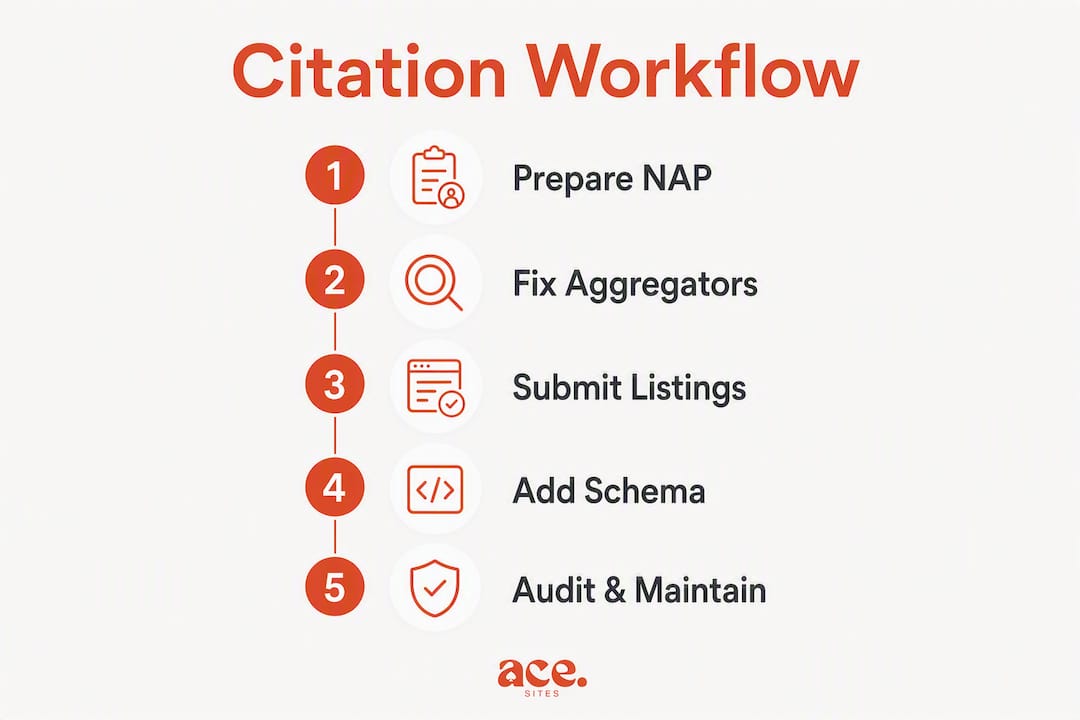
Step 1: prepare your canonical NAP document
Before you touch a single directory, build a spreadsheet with these columns: business name, address line 1, address line 2, town, county, postcode, phone number, website URL, business category (primary), business category (secondary), opening hours, short description (150 characters), long description (500 characters). Copy-paste from this document every time. Never type your address from memory.

Step 2: fix your data aggregators first
Data aggregators push business information to hundreds of downstream directories. If your aggregator record is wrong, it will overwrite any manual corrections you make elsewhere. In the UK, the main aggregators feeding local data are Neustar Localeze and Data Axle. Search for your business on both and correct any errors before submitting anywhere else.
Step 3: claim and complete Tier 1 listings
For each platform, the process follows the same pattern:
- Search for an existing listing before creating a new one. Duplicates are harder to fix than incorrect listings.
- Claim ownership via the platform's verification process (postcard, phone, email, or video depending on the platform).
- Fill every available field using your canonical NAP document.
- Add at least three photos: your logo, your premises or team, and a service or product image.
- Select the most specific category available. "Plumber" beats "Home Services" every time.
Step 4: add LocalBusiness schema to your website
Your website itself is a citation. Adding LocalBusiness schema markup to your site tells search engines your NAP in a structured, machine-readable format. This reinforces every directory listing you have and reduces the chance of conflicting data. If you are not sure how to implement it, the Ace-sites guide on local business schema walks through the process clearly.
Pro Tip: Fix your data aggregators before submitting to any new directories. An uncorrected aggregator record can push wrong data to hundreds of sites and undo hours of manual work.
How do you audit citations and keep them accurate over time?
Running your audit
Start with these search queries to find existing mentions:
"Your Business Name" "Your Town"
Log every result in a spreadsheet with columns for: platform name, URL of listing, current NAP as shown, correct or incorrect (Y/N), action needed, date fixed.
Then check the major platforms directly: Google Business Profile, Bing Places, Apple Maps, Facebook, Yell.com, and Trustpilot. Look for duplicate listings on each. A duplicate on GBP is particularly damaging because it splits your reviews and confuses Google about which listing to rank.
Tools that save time
- Moz Local — scans major data aggregators and directories, highlights inconsistencies, and lets you push corrections from a single dashboard.
Maintenance schedule
Quarterly audits are the recommended cadence because data aggregators can overwrite corrected listings without warning. Set a calendar reminder every three months to re-run your search queries and check your top-tier listings.
When your business details change (new phone number, new address, new hours), update in this order:
- Update your website and LocalBusiness schema first.
- Update Google Business Profile.
- Update data aggregators.
- Work through Tier 1 directories, then Tier 2.
What citation mistakes do UK businesses most commonly make?
Most citation problems come down to a handful of recurring errors. Here is what to watch for and how to fix each one.
- NAP variants — "High Street" in one place, "High St" in another. Search engines may not cluster these as the same business. Fix: copy from your canonical NAP document every time, without exception.
The most damaging citation error is not a wrong phone number. It is a data aggregator holding incorrect information and silently pushing it to hundreds of directories, undoing every manual correction you have made. Always fix the aggregator first.
Red flags that should trigger an immediate audit: a sudden drop in local rankings with no obvious on-site cause; a customer reporting they found a different phone number for you online; a new address appearing on your GBP that you did not add.
How long does citation work take and what does it cost?
Timelines
Tier 1 changes (Google Business Profile, Apple Maps, Bing Places) typically appear within 24–72 hours. Aggregator corrections take longer: propagation across downstream directories can take 2–8 weeks. Full ranking movement from a citation clean-up often takes 6–12 weeks, so do not expect overnight results.
Typical costs for UK small businesses
- Managed listing tools — BrightLocal and Moz Local charge monthly fees (pricing varies; check their current plans). These are worth considering if you manage citations for multiple locations or want automated monitoring.
The sweet spot for most UK small businesses is 20–30 high-quality citations rather than hundreds of low-authority ones. Beyond that threshold, the marginal return drops sharply. Spend the saved time on earning local press mentions and chamber listings instead.
If you outsource, ask the provider for a shared spreadsheet, login details, and confirmation of indexation. Any reputable service will provide this without hesitation.
Why do UK-specific citations outperform mass directory listings?
Local and industry-specific citations carry stronger geographic and topical relevance signals than generic global directories. A mention in your local chamber of commerce directory tells Google you are a real, established business in a specific town. A mention in your trade body's member list tells Google what you do. Neither of those signals comes from a generic directory that lists every business in every country.
High-value UK-specific sources to target:
- Local chamber of commerce directories — Most UK chambers maintain a searchable member directory. Membership often costs £100–£300 per year, but the citation value and networking benefit make it worthwhile for most local businesses.
Pro Tip: To earn a local press mention, contact your local newspaper's business desk with a genuine news hook: a new service launch, a community initiative, or a local award. Journalists covering local business are often short of material. A well-written press release with your full NAP in the footer creates an unstructured citation and builds local brand awareness at the same time.
For UK-focused local ranking tactics that complement your citation work, the Ace-sites guide on ranking in UK local searches covers the on-site signals that reinforce everything you build here.
Key takeaways
Consistent NAP data across 20–30 authoritative UK sources, starting with Google Business Profile and data aggregators, delivers most of the local SEO benefit from citation building.
| Point | Details |
|---|---|
| Define your canonical NAP first | Create a spreadsheet with your exact name, address, and phone number and copy-paste it into every listing. |
| Claim GBP and Tier 1 listings | Google Business Profile, Bing Places, Apple Maps, Facebook, and Yell.com are the highest-return starting points. |
| Fix aggregators before anything else | Incorrect aggregator data overwrites manual corrections across hundreds of directories. |
| Audit every quarter | Data aggregators can push wrong information without warning; a quarterly check keeps your listings accurate. |
| Ace-sites for citation-ready websites | Ace-sites builds local business websites with built-in SEO tools and LocalBusiness schema support to reinforce your citation work. |
Why fixing citations and your website together gets better results
There is a pattern worth pointing out. Businesses that clean up their citations but leave their website with no LocalBusiness schema, an inconsistent address in the footer, or a phone number that differs from their GBP tend to see slower ranking improvements than those who treat the website and the citation profile as one connected system. Search engines cross-reference your site against your directory listings. When the data matches, confidence in your business entity goes up across the board.
The businesses that see the clearest local ranking gains are usually those that do three things at once: correct their aggregator data, complete their Tier 1 listings, and add structured data to their website. None of those three steps is technically complex, but they are easy to do in the wrong order or to leave half-finished. The aggregator fix is the one most people skip, and it is the one that quietly undoes everything else.
If you are working through this process and want a practical reference for the on-site side of things, the Ace-sites guide on ranking locally on Google covers the website signals that sit alongside citation work.
Get your website citation-ready with Ace-sites
Citations point customers to your website. If that website is slow, hard to navigate, or missing your NAP in a machine-readable format, you are losing the benefit of every listing you have built.

Ace-sites builds professional websites for UK small businesses with built-in SEO tools, LocalBusiness schema support, and consistent NAP placement baked in from the start. There are no hidden costs, no agency retainers, and no technical knowledge required on your part. You can see your site before you pay a penny with the free done-for-you website build, or browse the full feature set to see how the built-in SEO tools work alongside your citation profile. For UK local businesses that want their online presence to actually convert, this is the practical next step.
This section is a promotional recommendation for Ace-sites services.
Useful sources and tools for UK citation building
A short list of authoritative resources to help you audit, build, and maintain your citations:
- Moz: What Is a Local Citation? — Clear explainer covering NAP, structured vs unstructured citations, and why consistency matters. A good starting reference.
- WordStream: How to Build Local Citations — Covers the relationship between citations and Google Business Profile, with practical advice on where to focus first.
- Google Business Profile — The primary platform for claiming and managing your GBP listing. Start here before any other directory.
- Trustpilot — UK-trusted review platform. Claiming your profile here adds both a citation and a review channel that feeds customer trust signals.
- OpenStreetMap — Open mapping platform that powers many third-party apps. Adding or correcting your listing here extends your reach beyond Google and Apple Maps.