
What website branding actually means for your business
Website branding is the deliberate practice of embedding your unique identity into every design, content, and structural element of your site. It covers your logo, colour palette, typography, brand voice, messaging, and the way your pages are laid out and connected. Done well, it tells visitors within seconds who you are, what you do, and why they should trust you.
For UK small businesses, this matters more than most owners realise. Your website is often the first place a potential customer forms an opinion about you. If the visuals feel inconsistent, the copy sounds generic, or the navigation is confusing, that trust evaporates before they have even read your services page.
The core elements of a branded website include:
- Logo and visual identity — your mark, applied consistently across every page
- Colour palette — three to five colours used across fonts, buttons, backgrounds, and graphics
- Typography — no more than three fonts, chosen to reflect your personality
- Brand voice — the tone and language used in all copy, from headlines to contact forms
- Site structure — how pages connect and guide visitors toward action
- Trust signals — testimonials, case studies, accreditations, and social proof
Weak branding acts like a leak in a bucket: you can pour money into ads and SEO, but poor conversion will drain the results away.
Table of Contents
- Why branding matters so much for UK small businesses
- How branding and website design must work together
- Core brand elements that make a website feel like yours
- What does website branding actually cost for a UK small business?
- What good website branding looks like for UK small businesses
- How to run a brand audit on your existing website
- Aligning your website's user experience with your brand identity
- Using imagery and multimedia to reinforce your brand
- How to measure whether your website branding is working
- Get a professionally branded website without the agency price tag
- Key takeaways
Why branding matters so much for UK small businesses
Recognition and trust are the two things that turn a website visitor into a paying customer. Branding builds both.

Web design heavily influences first impressions, which means your visual choices are doing most of the persuasion before a single word is read. For a small business competing against larger, better-funded rivals, that first impression is one of the few places you can genuinely punch above your weight.
Strong branding also gives you pricing power. A business that looks polished and consistent can charge more than one that looks cobbled together, even when the underlying service is identical. Customers associate professional presentation with quality and reliability.
The practical benefits for UK small businesses are clear:
- Consistent branding makes your marketing more effective across every channel
- A recognisable identity encourages repeat business and word-of-mouth referrals
- Clear messaging reduces the time visitors spend deciding whether to enquire
- Cohesive visuals and copy reduce bounce rates and improve time on site
Without a coherent brand, every new marketing effort starts from scratch. With one, each campaign reinforces the last.
How branding and website design must work together
Branding is not a byproduct of design. It is the foundation that guides every design decision, from the colours you choose to the order of your navigation links.
A common mistake is to build a website first and try to apply branding afterwards. The result is usually a site that looks fine but feels hollow — visually competent, but without a clear point of view. Visitors sense the absence even if they cannot name it.
Your site architecture should answer four questions: who you serve, what you offer, why customers should believe you, and what they should do next. Every page, heading, and call-to-action should map back to one of those four.
- Let your brand values determine the visual style, not the other way around
- Write copy that sounds like a person, not a corporate brochure
- Keep navigation simple and consistent with your overall tone
- Avoid chasing design trends that conflict with your established identity
Pro Tip: Before you touch a colour picker or choose a font, write down three words that describe how you want customers to feel when they land on your site. Every design decision should pass that three-word test.
Core brand elements that make a website feel like yours
Visual identity, voice, and trust signals are the three pillars that make a website feel coherent and credible. Each one needs deliberate attention.
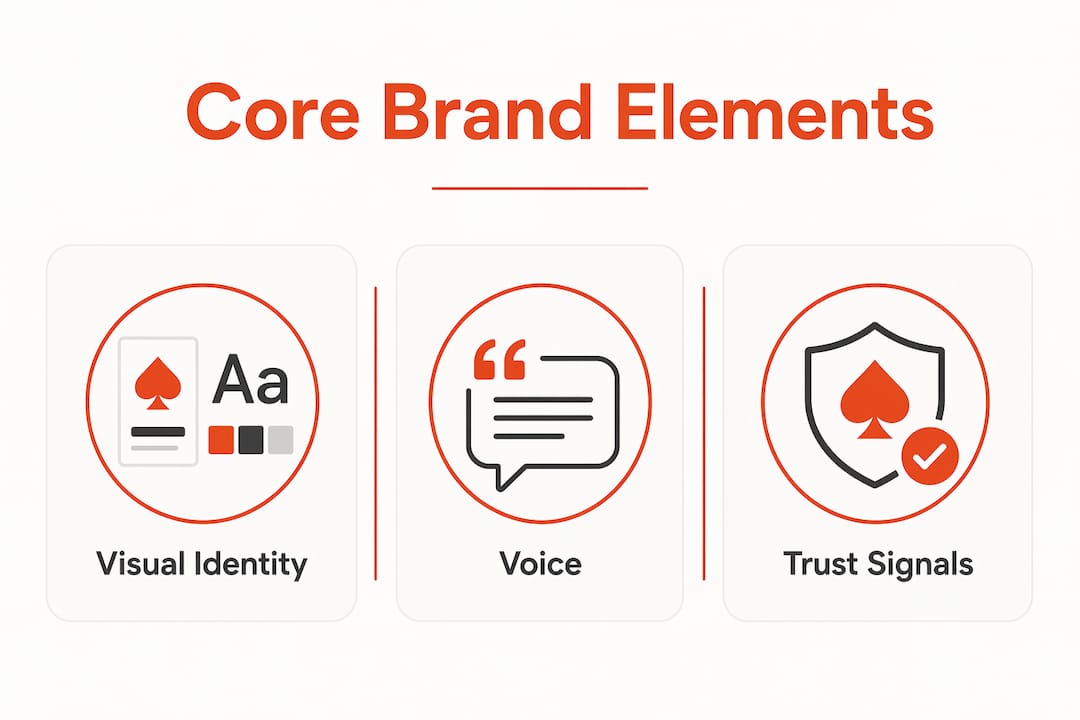
Your logo should appear consistently in the header, footer, and as a favicon. Brand colours need to meet WCAG AA contrast ratios — a minimum of 4.5:1 for body text — both for accessibility and for recognition. Typography should be limited to two or three typefaces applied consistently across headings, body copy, and buttons.
Brand voice is where many small businesses fall short. Effective messaging opens with the customer's problem, not a company history. If your homepage leads with "Welcome to our website," you have already lost the reader's attention.
Trust signals close the gap between interest and action. These include:
- Customer testimonials with names and locations
- Case studies showing real outcomes
- Accreditations, trade memberships, or certifications
- Clear contact details and a physical address where relevant
| Branding pillar | Function on your website |
|---|---|
| Visual identity | Creates instant recognition and sets the professional tone |
| Brand voice | Builds rapport and communicates your values through copy |
| Value proposition | Tells visitors exactly what you do and why it matters to them |
| Trust signals | Reduces hesitation and supports the decision to enquire |
| Site structure | Guides visitors logically toward the action you want them to take |
A brand style guide pulls all of this together. It acts as the single source of truth for anyone who touches your website — whether that is you, a designer, or a copywriter.
Pro Tip: Apply your branding to the parts of your site visitors rarely think about: your 404 error page, loading states, and email confirmation messages. Consistency in those moments signals genuine professionalism.
What does website branding actually cost for a UK small business?
There is no single answer, because the investment depends on where you are starting from and how much you do yourself. That said, here is a realistic picture.
A basic brand identity — logo, colour palette, typography guidelines — from a freelance designer in the UK typically starts from a few hundred pounds and rises significantly for more experienced practitioners. A full brand style guide with web-specific application rules sits at the higher end of that range. Website design and build costs vary widely depending on complexity and whether you use a platform or commission a bespoke site.
Factors that affect your branding investment include:
- Whether you already have a logo and visual identity in place
- The number of pages and content types your site requires
- Whether you need copywriting as well as design
- The platform you build on and its ongoing subscription cost
- Whether you opt for a done-for-you service or a self-build approach
The most important thing to understand is that branding is not a one-off cost. Regular audits — a quick monthly check, a quarterly review of key pages, and a full refresh annually — keep your site aligned with how your business evolves.
What good website branding looks like for UK small businesses
The strongest examples of small business website branding in the UK share a few common traits: they are immediately clear about who they serve, they use a consistent visual identity across every page, and they sound like a real person wrote the copy.
A local trades business, for example, might use a bold, high-contrast colour scheme that signals reliability, lead with a headline addressing the customer's specific problem, and back it up with local testimonials and a visible phone number. A boutique consultancy might use restrained typography and muted tones to signal expertise, with case studies doing the trust-building work. You can see how this plays out across different sectors in the Ace-sites portfolio, which showcases live branded websites built for UK small businesses.
The common thread is intentionality. Every choice — colour, font, image, word — is made in service of a clear brand position.
How to run a brand audit on your existing website
A brand audit is a structured review of whether your site actually reflects your brand as it stands today. It does not need to take long.
Start by opening every main page of your site and asking: does this look and sound like the same business? Check for mismatched logos, inconsistent font use, outdated imagery, and copy that no longer reflects what you offer. Then compare your website against your social media profiles and any printed materials. Gaps between channels are a reliable sign that your brand guidelines need updating.
The key questions to work through:
- Is the logo the same version across every page and channel?
- Are the same two or three fonts used consistently throughout?
- Does the copy use the same tone and vocabulary on every page?
- Are the colours consistent, including on buttons and links?
- Do the images feel like they belong to the same visual world?
Any "no" answer is a priority fix. Understanding visitor behaviour data can also reveal which pages are losing people, pointing you toward where brand inconsistency is costing you enquiries.
Aligning your website's user experience with your brand identity
User experience and branding are not separate disciplines. A slow, cluttered site undermines a polished visual identity just as effectively as a mismatched logo would.
Start with page load speed. Compress images, reduce unnecessary scripts, and test on mobile — the majority of UK small business website traffic now arrives on phones. Then review your navigation: does it reflect the way your customers think about your services, or the way you think about your own business? Those two things are often different.
Steps to align UX with your brand:
- Map the journey from landing page to enquiry and remove any friction points
- Use consistent button styles and calls-to-action that match your brand colours
- Write microcopy (form labels, error messages, confirmation text) in your brand voice
- Test your site on multiple devices and browsers to catch visual inconsistencies
- Make sure your website builds trust at every stage of that journey
Using imagery and multimedia to reinforce your brand
Photography and video are among the fastest ways to communicate brand personality, and among the most commonly mishandled.
Stock photography is fine as a starting point, but generic images of smiling people in offices do nothing to differentiate you. Where possible, use real photos of your work, your team, or your premises. Customers respond to authenticity, and a genuine image of your actual service in action carries more weight than a polished stock shot.
When choosing imagery, apply the same discipline you use for colour and typography: does this image feel consistent with the rest of the site? Does it reinforce the brand personality you have defined? Video works particularly well for service businesses — a short clip explaining what you do and who you help can do more for trust than three paragraphs of copy.
How to measure whether your website branding is working
Branding is not purely subjective. There are clear signals that tell you whether your site is building trust and converting visitors effectively.
Key metrics to track:
- Bounce rate — a high bounce rate on key pages often signals a mismatch between what visitors expected and what they found
- Time on site — longer sessions suggest visitors are engaging with your content and finding it credible
- Enquiry or conversion rate — the clearest measure of whether your brand is doing its job
- Return visitor rate — repeat visits indicate recognition and trust
- Brand search volume — if more people are searching for your business by name over time, your brand is gaining traction
Google Analytics 4 gives you access to most of these metrics at no cost. Pair it with regular reviews of your website enquiry performance to understand which pages and brand elements are driving results and which need attention.
Get a professionally branded website without the agency price tag
If you have read this far and you are looking at your current site thinking it needs work, Ace-sites is worth a look. It is built specifically for UK small businesses that want a professional, branded website without spending months on a design project or committing to a large agency fee.
With Ace-sites, you get a fully customisable site with built-in SEO tools, a blog manager, contact forms, and mobile-optimised templates — all designed so you can apply your brand consistently without needing a developer. The done-for-you option means Ace-sites builds the site for you, and you pay nothing until you have seen it. For a small business that needs to get online quickly and look credible from day one, that is a practical starting point. Visit ace-sites.co.uk to see what is possible.
Key takeaways
Effective website branding combines consistent visual identity, clear messaging, and a user experience that reinforces your brand promise at every point of contact.
| Point | Details |
|---|---|
| Branding drives design | Define your brand identity before making any design decisions — not after. |
| Consistency builds trust | Mismatched logos, colours, and copy undermine credibility faster than poor traffic ever will. |
| Audits keep you aligned | Run a quick monthly check and a full brand review annually to catch drift before it costs you. |
| UX is part of your brand | A slow or confusing site damages brand perception regardless of how good the visuals are. |
| Ace-sites for fast launch | Ace-sites gives UK small businesses a branded, professional website with no upfront cost to view. |