
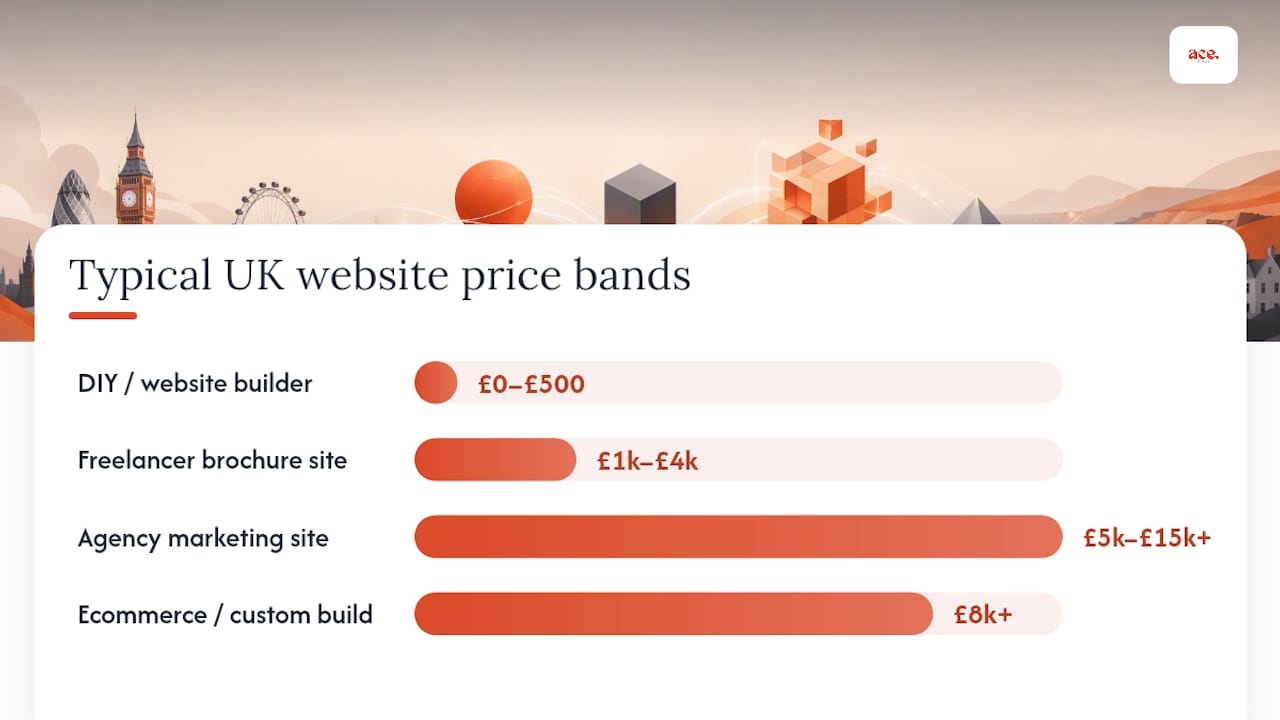
A professionally built website in the UK typically costs between £600 and £15,000 or more in 2026, depending on how much of the work is bespoke. Here is what that looks like across the main routes:
- DIY / website builder: £0–£500 upfront, plus £10–£50 per month on subscription
- Freelancer brochure site: typically a few thousand pounds for a standard 5–8 page site
- Agency marketing site: commonly starting around several thousand pounds for a fully designed, content-rich site
- Ecommerce or custom build: often ranges from several thousand to tens of thousands of pounds depending on catalogue size and integrations
- Web app or bespoke platform: typically starting from a high four-figure or low five-figure sum upwards
For most small UK businesses launching their first proper site, a freelancer in the £1,500–£3,000 range or a good website builder at £20–£40 per month covers the majority of needs. If you are running a growing service business or local retail operation, the agency band starts to make sense once you need custom design, SEO strategy, and ongoing support built in from day one.
Key takeaways
| Point | Details |
|---|---|
| Know your band | DIY builders cost £120–£425 for year one; freelancer brochure sites run £1,500–£3,000 all in; agency builds start at £5,000 and climb past £15,000. |
| Budget for content | Copy and photography are excluded from most quotes; add £600–£1,300 for a five-page service site with professional copy and a half-day shoot. |
| Plan annual running costs | Budget 10–15% of your build cost per year for maintenance, plus £120–£600 for hosting and domain renewal depending on your setup. |
| Ask the right questions | Confirm deliverables, revision limits, ownership of domain and files, VAT status, and payment milestones before signing any contract. |
| Ace-sites option | Ace-sites offers a self-build SaaS platform and a done-for-you service, covering the DIY and freelancer bands with fast turnaround and no hidden costs. |
Table of Contents
- What actually drives website design costs in the UK?
- What do UK website pricing bands actually include?
- Upfront build costs versus ongoing running costs
- Which features will push your costs up significantly?
- How to choose the right route and what to ask suppliers
- How long does each route take?
- Three worked UK budget scenarios
- Why these figures are reasonable for UK small businesses in 2026
- An honest view on which route actually makes sense
- Ace-sites: a practical option for small UK businesses
- Sources
What actually drives website design costs in the UK?
The single biggest lever on website design cost is how much of the site must be built from scratch. A designer who recolours an existing theme and swaps in your logo is doing a fraction of the work compared to one creating original layouts, a custom design system, and bespoke components. That gap between a theme swap and a fully bespoke design accounts for most of the price difference between the low and high ends of each band.
Beyond design, these are the factors that move a quote up or down:
- Content: Copy, photography, and video are frequently excluded from quotes. A copywriter typically charges £300–£800 for a five-page site; professional photography adds £300–£1,500 or more. Founders who forget to budget for content often find their project stalls for weeks waiting on assets.
- Functionality: Ecommerce, booking systems, membership areas, and custom search filters all add significant development time. Each one is a project within a project.
- Integrations: Connecting your site to a CRM, stock management system, or third-party booking platform requires API work that adds hours and cost.
- Accessibility and compliance: Meeting WCAG 2.1 AA standards (increasingly expected for public-facing UK sites) adds audit and remediation time. If your site processes personal data, GDPR-compliant cookie management and privacy tooling is also a cost line.
- Team seniority and location: A London agency with senior strategists and a dedicated project manager charges more than a regional freelancer working solo. UK agency day rates for senior teams commonly sit at £600–£1,200 per day, and those rates feed directly into your quote.
- Revisions: Most freelancers and agencies include two or three rounds of revisions. Additional rounds cost extra, and scope creep during revisions is one of the most common causes of budget overrun.
Pro Tip: Bespoke design is worth the extra spend when your brand genuinely needs to stand out from competitors, when conversion rate matters (e.g. a high-ticket service), or when you are building something that will serve as a long-term marketing asset. For a test site or a simple local presence, a well-chosen template is a perfectly sensible starting point.
What do UK website pricing bands actually include?
UK website costs range from a few hundred pounds for a DIY builder to well over £15,000 for a custom agency build. The table below maps each band to what you typically get and what is usually left out:
| Band | Typical price range | Usually included | Commonly excluded |
|---|---|---|---|
| DIY / website builder | £0–£500 upfront + £10–£50/month | Hosting, SSL, templates, basic SEO tools | Custom design, copywriting, photography |
| Freelancer brochure site | £1,000–£4,000 | Design, build, basic on-page SEO, contact form | Content creation, ongoing maintenance, hosting |
| Agency marketing site | £5,000–£15,000+ | Strategy, bespoke design, copywriting, SEO setup | Paid ads management, ongoing retainer, photography |
| Ecommerce / custom build | £8,000+ | Product pages, payment gateway, stock management | Third-party integrations, custom filters, ongoing dev |
| Web app / bespoke platform | several thousand to tens of thousands | Full custom development, UX research, QA | Hosting infrastructure, ongoing feature development |
Common exclusions across all bands worth flagging separately:
- Professional copywriting and proofreading
- Stock image licences or commissioned photography
- Third-party plugin or software licences (e.g. booking tools, live chat)
- Ongoing hosting and maintenance after launch
- Google Analytics or tag management setup
- Domain name registration and renewal
A useful real-world illustration: a small-business brochure site built by a professional typically lands in the low-to-mid thousands, but the final invoice often surprises owners who did not account for copywriting and a stock image licence on top of the design fee. Ask for a fully itemised quote before signing anything.
As Expert Market notes, builder subscriptions can cost from under £10 per month to £30–£50 per month for more advanced plans, which makes them genuinely competitive for businesses that do not need custom functionality.
Upfront build costs versus ongoing running costs
Planning only for the build is one of the most common budgeting mistakes small business owners make. The site goes live, and then the invoices keep arriving: hosting renewals, domain fees, security updates, plugin licences. Budget for these from day one.
Typical ongoing line items to account for:
- Domain name: £10–£20 per year for a .co.uk; .com domains are slightly more
- Hosting: £5–£30 per month depending on server type and provider; managed WordPress hosting sits at the higher end
- SSL certificate: Usually included with modern hosting plans, but worth confirming
- CMS or platform fees: Builder subscriptions run £10–£50 per month; some CMS licences add a separate annual fee
- Maintenance and security: Plugin updates, CMS core updates, uptime monitoring, and backups
- Content updates: Either your own time or a developer's hourly rate (typically £50–£100 per hour for a UK freelancer)
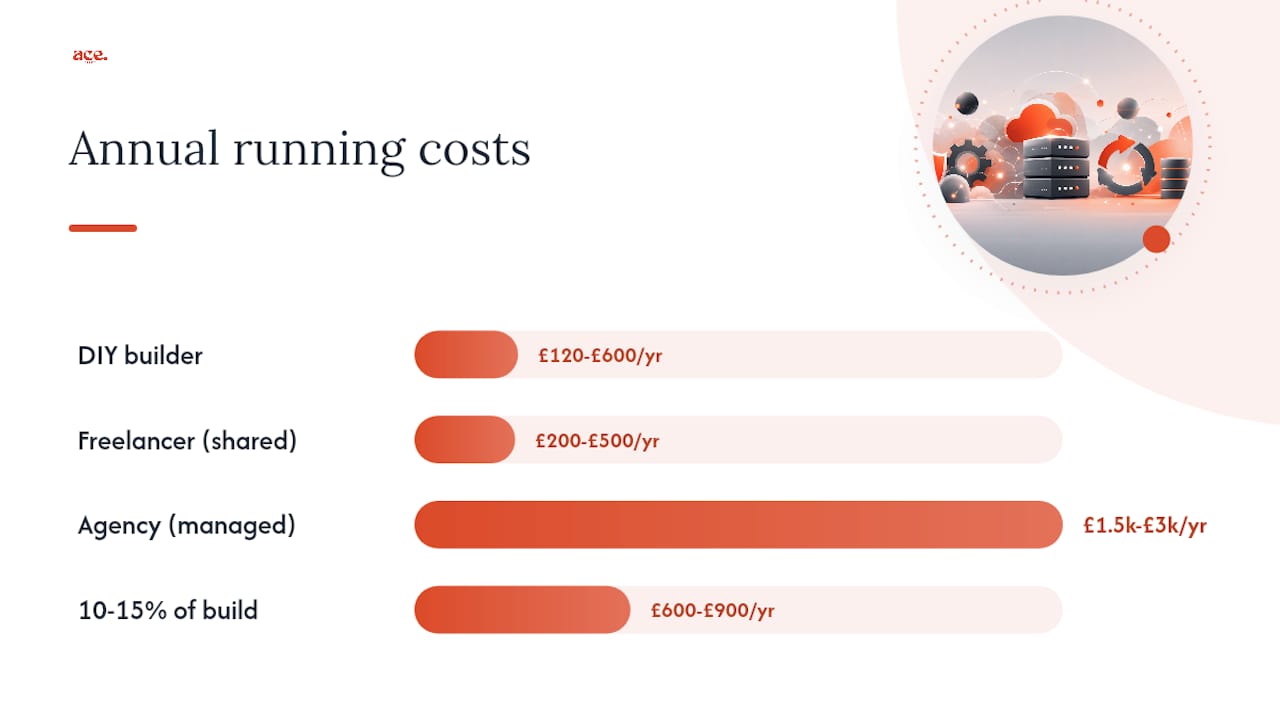
A sensible rule of thumb: budget 10–15% of your initial build cost per year for maintenance and small changes. A £6,000 agency site therefore realistically adds £600–£900 per year in running costs, on top of hosting and domain fees.
For a DIY builder, annual running costs are simpler: your subscription covers hosting and SSL, so you are typically looking at £120–£600 per year all in. For a freelancer-built site on shared hosting, expect £200–£500 per year. An agency-built site with managed hosting and a support retainer can run to £1,500–£3,000 per year.
You can explore how to publish a website for a practical checklist of what to set up at launch to avoid surprise costs later.
Which features will push your costs up significantly?
Some features are genuinely expensive to build well. Knowing which ones carry a material uplift lets you decide what to include at launch and what to defer until revenue justifies it.
- Ecommerce and payment flows: Adding a product catalogue, checkout, and payment gateway typically adds £2,000–£8,000+ to a build, depending on catalogue size and whether you need custom product pages or filters.
- Booking systems: A simple embedded booking widget (e.g. Calendly or Acuity) costs little to integrate. A custom-built booking system with availability rules, automated reminders, and staff management adds £1,500–£5,000.
- Membership areas: Gated content, login portals, and tiered access require significant back-end work. Budget £2,000–£6,000 for a basic membership build.
- Multi-language support: A properly translated site with hreflang tags and separate content management adds £500–£2,000 depending on the number of languages.
- Complex integrations: Connecting to a CRM like HubSpot or Salesforce, or syncing with a stock management system, typically adds £500–£3,000 per integration.
- Custom search and product filters: Faceted search for large catalogues is one of the most underestimated cost lines. Expect £1,000–£4,000 for a well-built implementation.
Pro Tip: Use MVP thinking when scoping your first build. Launch with the core pages and a contact form, then add ecommerce or booking functionality once you have validated demand. Staging expensive features saves money upfront and gives you real user data to inform the next phase.
How to choose the right route and what to ask suppliers
The right route depends on four things: your budget, how much control you want over the site day-to-day, how quickly you need to go live, and whether your brand genuinely needs bespoke design.
A simple decision framework:
- Under £500 total budget: A website builder is your only realistic option. Choose one with built-in SEO tools and mobile-optimised templates.
- £1,000–£4,000 and need something professional quickly: A freelancer with a strong portfolio in your sector is the most cost-effective route.
- £5,000+ and growth-focused: An agency gives you strategy, accountability, and a senior team. Worth it when the site is a primary revenue driver.
- Ecommerce from day one: Go straight to a specialist. A generalist freelancer building their first WooCommerce store is a risk at this price point.
For comparing platforms, the best website builder UK guide covers the main options and their trade-offs in detail.
Questions to ask every supplier before you sign
- What exactly is included in this quote? List every deliverable.
- How many rounds of revisions are included, and what counts as a revision?
- Who is responsible for supplying copy and images?
- Where will the site be hosted, and who controls the hosting account?
- Will I own the domain name and the site files outright at the end of the project?
- What happens if the project runs over the agreed timeline?
- What support is available after launch, and at what cost?
- What is the payment schedule, and what triggers each payment?
- Do you have references from similar projects I can speak to?
- Is the quote inclusive of VAT?
Red flags to watch for:
- No written quote or contract, only a verbal agreement
- Vague deliverables ("a website" with no page count or feature list)
- A price that is significantly below every other quote you have received
- No references or portfolio examples in your sector
- Requests for full payment upfront before any work begins
Pro Tip: Tie payment milestones to deliverables in the contract: a deposit on signing, a second payment on design approval, and the final payment on launch. Never pay the final instalment before the site is live and you have tested it thoroughly.
How long does each route take?
Timeline expectations vary considerably by route. Content delays and revision rounds are the most common causes of projects running late, regardless of who builds the site.
- DIY builder: Hours to a few days for a basic site; a week or two if you are writing all the copy yourself
- Freelancer brochure site: 1–4 weeks from brief to launch, assuming content is ready at the start
- Agency marketing site: 4–12 weeks, sometimes longer for complex briefs or multiple stakeholders
- Ecommerce or custom build: 8–20 weeks, depending on catalogue size, integrations, and testing requirements
- Web app or bespoke platform: Several months; some projects run 6–12 months from discovery to launch
The most reliable way to keep a project on track is to have all your content (copy, images, brand assets) ready before the build starts. Waiting on a logo or a product description sheet mid-project is the single most common cause of delay.
Pro Tip: Ask your supplier to include milestone dates in the contract, not just a launch date. A milestone for design sign-off, a milestone for content handover, and a milestone for testing gives both sides clear accountability and makes it easier to spot a delay early.
Three worked UK budget scenarios
These three scenarios are illustrative examples based on typical UK market rates. Actual costs will vary by supplier, location, and scope.
Scenario A: Sole trader testing demand with a builder
A sole trader wants a simple online presence to test whether customers search for their service locally. Speed and low cost are the priority.
| Cost line | Estimated cost |
|---|---|
| Website builder subscription (annual) | £120–£360 |
| Domain name (.co.uk, first year) | £10–£15 |
| Stock images | £0–£50 |
| DIY copywriting | £0 (own time) |
| First-year total | £120–£425 |
This works well when you are not yet sure whether the business needs a full site. If it does, you can migrate to a freelancer or agency build once you have validated demand.
Scenario B: Small service business with a freelancer brochure site
A local plumber or accountant wants a five-page site with a contact form, Google Maps embed, and basic on-page SEO. They have a logo but need copy and one round of professional photography.
| Cost line | Estimated cost |
|---|---|
| Freelancer design and build | £1,800–£2,000 |
| Copywriting (5 pages) | £400–£600 |
| Photography (half-day shoot) | £400–£600 |
| Domain name | £10–£15 |
| Shared hosting (first year) | £120 |
| First-year total | £1,500–£3,000 |
Annual running costs from year two: roughly £200–£400 for hosting, domain, and minor updates. Budget an additional £300–£500 if you want a freelancer to make content changes during the year.
Scenario C: Local retail business launching a modest ecommerce store
A local gift shop wants to sell online with up to 100 products, a Stripe payment integration, and basic stock management. They need an agency with ecommerce experience.
| Cost line | Estimated cost |
|---|---|
| Agency design and build | £6,000–£10,000 |
| Ecommerce setup and payment integration | £1,500–£3,000 |
| Copywriting and product descriptions | £600–£1,200 |
| Photography (product shots) | £500–£1,500 |
| Domain name | £10–£15 |
| Managed hosting (first year) | £300–£600 |
| First-year total | £5,000–£15,000 |
Annual running costs from year two: £900–£1,800 for hosting, maintenance, and security, plus any ongoing development.
Why these figures are reasonable for UK small businesses in 2026
The price bands in this guide are drawn from published UK market sources and reflect current agency day-rate norms and builder subscription pricing. The ranges are not invented; they are grounded in what UK suppliers actually charge.
The primary methodology: cross-referencing published cost guides from UK-focused web design market sources, checking against agency day-rate data, and applying those rates to typical project scopes. Where sources disagreed, the more conservative figure was used.
Senior UK agency day rates typically sit at £600–£1,200 per day. A five-page brochure site requiring roughly five to eight days of senior design and development time therefore costs £3,000–£9,600 in labour alone, before project management, hosting setup, or content work. That arithmetic explains why agency quotes for a "simple" site often surprise small business owners.
If you are based in Manchester, Leeds, or Bristol, you have more room to negotiate without sacrificing quality.
Always confirm whether a quote is inclusive or exclusive of VAT before comparing figures. A £5,000 quote ex-VAT becomes £6,000 once VAT is added.
The page count versus bespoke work distinction matters here too. A ten-page site built on a template costs less than a five-page site with fully custom layouts. Scope is what drives cost, not page count.
An honest view on which route actually makes sense
There is a tendency in web design guides to present every option as equally valid and leave the reader to decide. That is not especially useful. Here is a more direct take.
For most sole traders and very small service businesses, a well-configured website builder or a mid-range freelancer build is the right starting point. The gap in quality between a good builder site and a £2,000 freelancer site is smaller than most people expect, and the gap between a £2,000 freelancer site and a £10,000 agency site is larger than most people budget for. The agency premium is real and justified when the site is a primary revenue driver, when you need ongoing strategic support, or when your brand genuinely requires custom design to compete.
What gets underestimated consistently is content. A beautifully designed site with weak copy and stock photos will underperform a modest template with strong, specific copy written for the right audience. If you have a limited budget, spend proportionally more on words than on design.
Ace-sites sits in a practical middle ground: a builder platform with enough flexibility for a professional result, plus a done-for-you option for businesses that want a managed launch without agency prices. For local service businesses that need to go live quickly and affordably, that combination covers most of what matters.
*— Gabbi
Ace-sites: a practical option for small UK businesses
If you have read this far and concluded that you want a professional result without agency fees or a long build timeline, Ace-sites is worth a close look.
The platform gives you visual editing, mobile-optimised templates, unlimited pages, built-in SEO tools, a blog manager, contact forms, booking widget embeds, an announcement bar, a pop-up builder, and SSL included. You can build and customise the site yourself with no technical knowledge, or choose the done-for-you service where the Ace-sites team builds it for you and you pay nothing until you have seen it.
That done-for-you option maps to the freelancer brochure band in terms of outcome, but with faster turnaround and no hidden revision costs. The self-build SaaS route sits firmly in the DIY builder band, with a monthly subscription that covers hosting, SSL, and platform access.
Browse the Ace-sites portfolio to see live examples of what the platform produces for local businesses, then start your free trial or request your done-for-you build at Ace-sites.
Sources
- How Much Does a Website Cost in the UK? (2026) | Coderacle
- How Much Does a Website Cost? DIY vs Designer
- Average Cost of Website Design for Small Business UK
- How Much Does a Website Cost UK 2026? Full Price Guide