
Wix, Squarespace, Bluehost, Duda HQ, and Ucraft are the strongest blog website builders available in the UK right now. Each one suits a different type of blogger, so the right pick depends on what you actually need: flexibility, visual polish, hosting reliability, agency-grade tools, or a no-fuss free start. The table below cuts straight to the comparison.
| Platform | Ease of Use | Starting Price | Free Plan | SEO Controls | Monetization | Best For | Rating |
|---|---|---|---|---|---|---|---|
| Wix | Very easy | — | Yes | Good | Strong | Flexible all-in-one blogging | — |
| Squarespace | Easy | £10/domain | No (14-day trial) | Good | Strong | Visual and creative blogs | 2.7★ (299) |
| Bluehost | Moderate | £4.99/mo | No (money-back guarantee) | Excellent | Good | WordPress-based blogs | 4.4★ (234) |
| Duda HQ | Moderate | Not listed | No | Excellent | Moderate | Agencies and SaaS teams | 4.6★ (216) |
| Ucraft | Very easy | Affordable | Yes (free hosting) | Moderate | Moderate | Startups and creative bloggers | 5★ (7) |
Industry reviews in mid-2026 consistently place Wix at the top for flexibility, Squarespace for image-heavy content, and Bluehost for anyone building on WordPress. All five platforms are fully available in the UK.
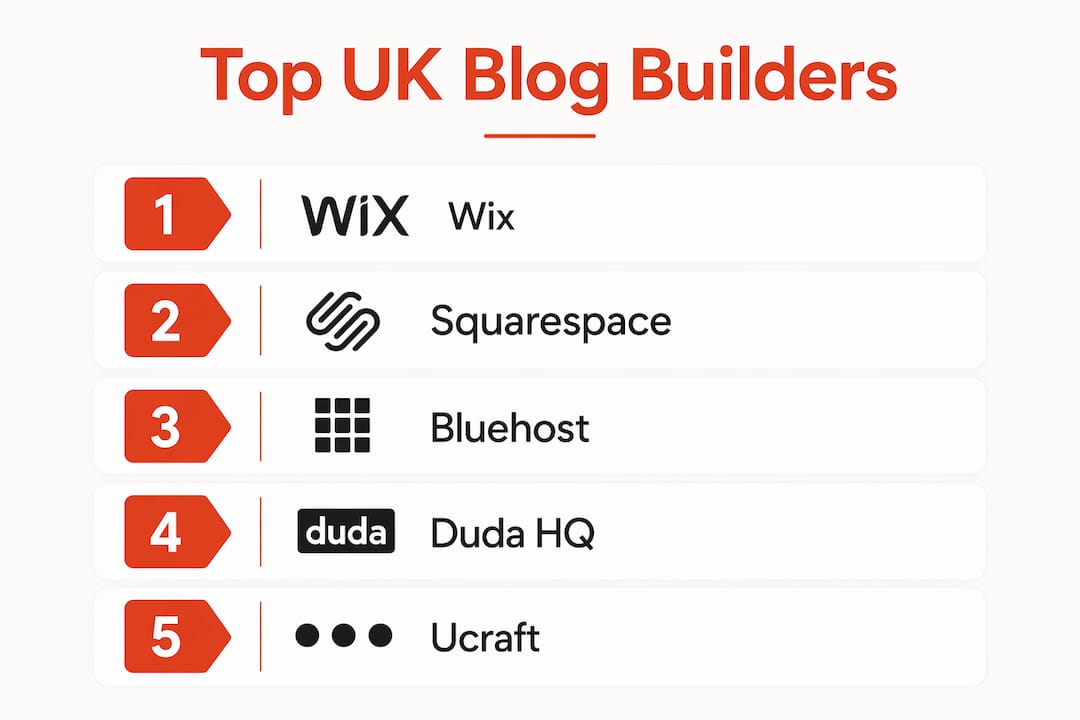
Which blog website builder is right for you in 2026?
Wix leads on flexibility. It offers a large library of blog-specific templates, an intuitive post editor, and built-in AI tools that help you write content, design pages, and manage members. If you want creative freedom without needing to touch any code, Wix is the easiest starting point.

Squarespace is the go-to for bloggers who care deeply about how their site looks. Its templates are genuinely polished, and the Blueprint AI tool can generate a custom design from scratch. There is no free plan, but a 14-day trial lets you test it properly before committing. Squarespace also supports memberships, scheduling, invoicing, and donations, so it grows with you as a creator.

Bluehost takes a different approach entirely. As the WordPress.org-recommended host, it pairs reliable hosting with an AI website builder, making it the strongest option if you want the full power of WordPress without managing a server yourself. Plans start at a modest monthly cost, and a money-back guarantee means you can try it without risk.
Duda HQ is built for professionals rather than solo bloggers. Its white-label platform, team collaboration tools, and client management features make it the clear choice for agencies building blogs at scale. For an individual blogger, it may feel like more than you need.
Ucraft rounds out the list as the friendliest option for startups and creative bloggers on a tight budget. It includes a drag-and-drop editor, an AI assistant, a logo maker, free hosting, and a built-in blogging platform. The trade-off is that SEO controls are less granular than Bluehost or Duda HQ.
Key strengths at a glance:
- Wix: Largest template library for blogs, strong AI tools, membership support
- Squarespace: Best visual templates, broad business integrations, no transaction fees on Commerce plans
- Bluehost: WordPress hosting, WooCommerce support, developer-friendly
- Duda HQ: White-label, team collaboration, advanced SEO and automation
- Ucraft: Free hosting, logo maker, AI assistant, beginner-friendly pricing
How to choose a blog builder that fits your goals
The single most useful question to ask yourself is: what do you want your blog to do in 12 months? That answer shapes everything else.
If you plan to earn money through subscriptions or memberships, prioritise platforms with built-in monetization tools. Squarespace handles memberships and paid newsletters natively. Wix supports member areas and paid content. Bluehost, running WooCommerce, gives you the most control over payment flows.
SEO is where many bloggers make a costly mistake. Not every platform that claims to be "SEO-friendly" gives you full manual control. Experts recommend choosing a builder that lets you edit meta titles, meta descriptions, and URL slugs yourself, rather than relying on automated suggestions. Bluehost and Duda HQ offer the most granular SEO controls of the five. Wix and Squarespace cover the basics well. Ucraft is adequate for a new blog but may limit you as you grow.
Pricing constraints matter too. If you need to start for free, Wix and Ucraft both offer free tiers with hosting included. Squarespace requires a paid plan after the trial. Bluehost's entry price is low, but you will need to pay for hosting from day one.
Before you commit to any platform, check these three things:
- Does the free plan or trial let you test the blog editor fully?
- Can you export your content if you decide to switch later?
- Does the platform support the integrations you already use, such as Mailchimp, Google Analytics, or a booking tool?
Pro Tip: For a UK-focused blog, prioritise a builder that lets you set custom meta titles and descriptions manually. Automated SEO tools are a helpful starting point, but manual control is what gives you an edge in local search results.
How to start a blog for free or on a budget in the UK
Starting a blog without spending money upfront is genuinely possible. Here is a straightforward path:
- Choose a free plan. Wix and Ucraft both offer free hosting with a subdomain (for example, yourname.wixsite.com). WordPress.com also has a free tier suited to content-heavy blogs.
- Pick a template. All three platforms offer ready-made blog templates. Choose one that matches your niche and customise the colours, fonts, and layout without touching any code.
- Use AI tools to speed things up. Wix's AI can draft your first blog posts and suggest a site structure. Ucraft's AI assistant helps with design decisions. These tools cut setup time considerably.
- Set up your domain later. Start on a free subdomain, then upgrade to a custom domain when you are ready to invest. Squarespace domains start at £10, and most platforms offer domain registration as an add-on.
- Budget for scaling features. Free plans limit storage, remove ads, and restrict monetization. Plan to move to a paid tier once your blog gains traction. Bluehost's entry plan at £4.99 per month is a cost-effective step up for WordPress users.
For an AI-assisted setup walkthrough, a step-by-step guide to using AI website builders covers the process clearly for small business owners new to the tools.
How do bloggers make money in the UK?
Monetization options vary more than most people expect, and the platform you choose directly affects which revenue streams are open to you.
- Display advertising: Platforms like Wix and WordPress.com support Google AdSense integration. You need consistent traffic before ad revenue becomes meaningful.
- Affiliate marketing: Works on any platform. You embed affiliate links in your posts and earn a commission when readers buy. No platform-level restrictions apply.
- Paid memberships and subscriptions: Squarespace supports this natively. Wix has a member area feature. For creators who want to keep the maximum share of subscription revenue, Ghost connects directly to Stripe, meaning no platform transaction fees beyond Stripe's own processing charge.
- Donations: Squarespace includes a donations feature. Wix supports PayPal and Stripe donation buttons.
- Selling products or services: Bluehost with WooCommerce gives you a full e-commerce setup. Squarespace handles digital downloads, physical products, and service bookings in one place.
The platform you choose shapes your monetization ceiling. If subscriptions are your primary goal, Squarespace or a creator-focused platform like Ghost will serve you better than a general-purpose builder.
How we evaluated these blog website builders
Every platform in this guide was assessed against the same set of criteria, applied consistently across desktop and mobile.
- Usability: How quickly can a non-technical blogger set up and publish a post?
- Pricing transparency: Are costs clear upfront, including renewal rates and transaction fees?
- Blogging features: Post scheduling, image optimisation, RSS feeds, categories, and tags.
- SEO capability: Manual control over meta data, URL structure, and sitemap submission.
- Monetization support: Native tools for ads, memberships, subscriptions, and e-commerce.
- Local relevance: UK availability, GBP pricing, and customer support accessible to UK users.
- User ratings: Verified ratings from real users, used as one signal alongside feature depth.
- Mobile performance: Template responsiveness and mobile editing capability tested directly.
Platforms were only included if they are fully available to UK users and offer meaningful blogging functionality, not just a basic page builder with a blog add-on.
Who owns your content, and can you take it with you?
Data ownership is one of the least-discussed but most important factors when choosing a blogging platform. If you build a blog with hundreds of posts and then decide to switch, the ease of exporting your content varies significantly between platforms.
WordPress-based setups, including Bluehost, give you the most portability. You own your files, your database, and your content outright. Exporting everything is straightforward. Squarespace allows you to export blog posts as an XML file, though some formatting and media may not transfer cleanly. Wix does not offer a direct content export tool, which means migrating away from Wix requires manual work or third-party scripts. Ucraft and Duda HQ have limited public documentation on export options.
Ghost, while not in this comparison, is worth noting for creators who prioritise ownership: it is open-source and creator-owned, meaning your data stays entirely under your control. For the platforms in this guide, Bluehost gives you the clearest path to portability, and Squarespace offers a workable middle ground.
Ace-sites: a straightforward alternative for UK small businesses
If you have read through the options above and thought "I just want a professional website up quickly, without the learning curve," Ace-sites is worth a look.
Ace-sites is built specifically for UK small businesses and local bloggers who need a professional site live fast, without hidden costs or a steep setup process. Unlike the self-serve platforms compared above, Ace-sites includes a built-in blog manager, SEO tools, mobile-optimised templates, and a booking widget, all in one monthly subscription with no technical expertise required. You can be live in under a day. For businesses that want someone else to handle the build entirely, the bespoke website design service means you pay nothing until you have seen the finished site. If you want to see what the platform can do before committing, the full features list covers everything included.
Key takeaways
Wix, Squarespace, and Bluehost are the strongest all-round blog website builders for UK users in 2026, each suited to a different blogging goal and budget.
| Point | Details |
|---|---|
| Best for flexibility | Wix offers the largest blog template library and strong AI tools for all blogger types. |
| Best for visual blogs | Squarespace suits creative and image-led blogs with polished templates and membership support. |
| Best for WordPress users | Bluehost, recommended by WordPress.org, offers competitively priced plans with a money-back guarantee. |
| Free starting options | Wix and Ucraft both offer free plans with hosting; Squarespace offers a 14-day trial instead. |
| Ace-sites for local businesses | Ace-sites gives UK small businesses a fast, no-fuss route to a professional blog and website. |